
Sintered Bronze Filters
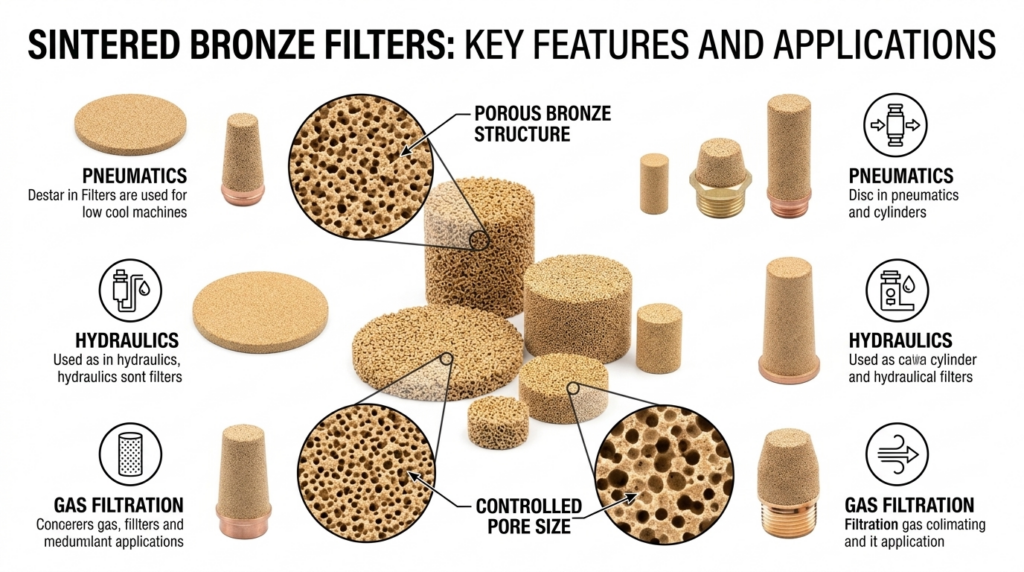
Porous Sintered Bronze Filter Elements for Controlled Filtration, Air/Oil Separation and Industrial Fluid Applications
Sintered bronze filters are porous metal filter components manufactured by compacting bronze powder into a defined shape and sintering it under controlled conditions. The interconnected pores provide a filtration path through the metal structure while maintaining the mechanical advantages associated with a rigid metallic filter element. Sintered Metal Filters are equipped with durable and effective sintered candles, these filters are very much effective for the filtration process. Sintered Bronze filter components are produced utilizing powder metallurgical system. All these items are utilized for filtration motivation behind fluids and gases. We are engaged in offering a wide array of Sintered Bronze Filter Elements.
We manufacture and supply sintered bronze filter components for industrial, OEM and replacement applications, with material, geometry, porosity and filtration characteristics selected according to the customer’s application requirements.
What is a Sintered Bronze Filter?
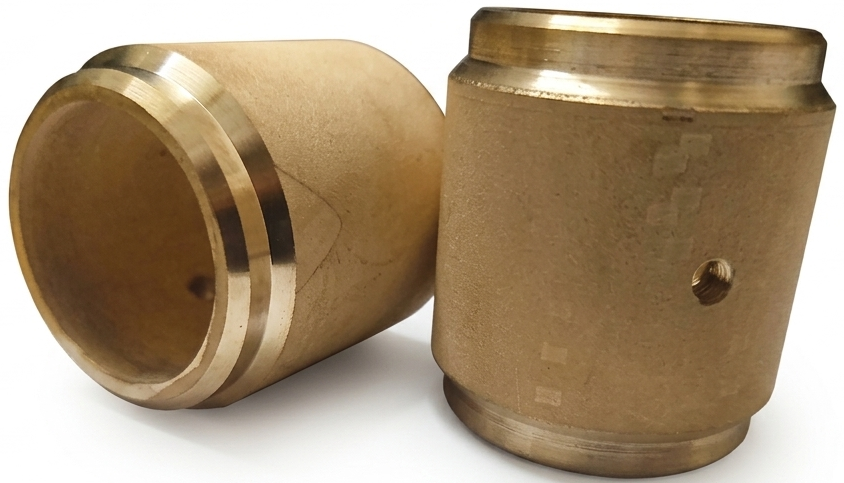
A sintered bronze filter is a porous metallic filter element produced through powder metallurgy.
Unlike conventional woven or perforated filters, the filtration structure is formed by interconnected pores within the sintered metal body.
A typical manufacturing sequence involves:
Bronze powder → Powder blending → Tooling/compaction → Green component → Sintering → Sizing/finishing → Inspection → Final filter
The final component can be produced in different geometries depending on the filtration system, installation arrangement and required flow path.
Why Bronze?
Bronze can be selected when a combination of:
- controlled porosity
- corrosion resistance appropriate to the service environment
- metallic construction
- mechanical rigidity
- reusable/cleanable filter construction
- dimensional stability
- application-specific filtration characteristics is required.
The actual suitability of a bronze filter depends on the bronze composition, pore structure, fluid, temperature, pressure, filtration requirement and operating conditions.
How Sintered Bronze Filters Work
The interconnected pore network allows the process medium to pass through the porous metal structure while particles are retained according to the filter’s pore characteristics and operating conditions.
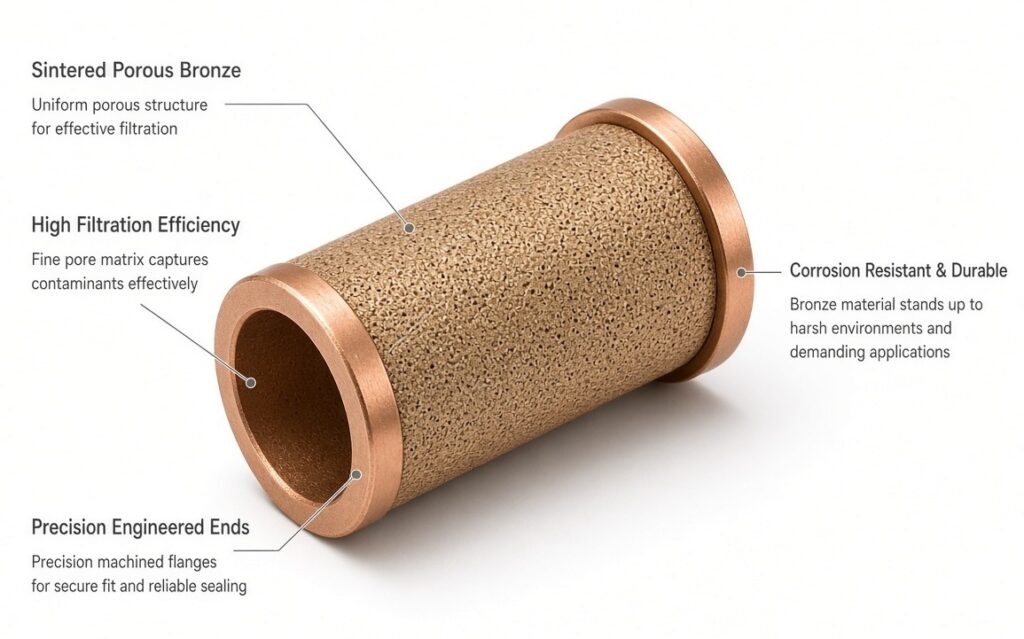
Simplified Filtration Path
Unfiltered medium
↓
Particle-containing flow
↓
Porous sintered bronze structure
↓
Particle retention
↓
Filtered medium
Actual filtration performance should be established from the specified pore/filtration requirement and application test conditions, rather than assuming that a nominal pore size alone determines performance.
Sintered Bronze Filter Materials & Grades
Material selection should be based on the required chemical composition, mechanical requirements, corrosion environment, operating temperature and manufacturing process.
Bronze Material
The filter can be manufactured from a suitable bronze powder composition selected for the customer’s application.
Where a specific standard or grade is required, the exact grade should be confirmed against the applicable material standard and manufacturing capability before quotation.
Material Specification
| Parameter | Status |
|---|---|
| Base material | Bronze |
| Bronze composition/grade | Application & specification dependent |
| Applicable material standard | Customer/project dependent |
| Powder characteristics | Manufacturing dependent |
| Porosity | Specification dependent |
| Density | Manufacturing/specification dependent |
| Surface finish | Geometry/application dependent |
| Mechanical properties | Grade and manufacturing dependent |
Standard vs Optional vs Application-Dependent Specifications
For engineering procurement, this distinction is important.
Standard / Normally Defined
These are parameters normally established as part of the product specification:
- Bronze material
- Component geometry
- Overall dimensions
- Filter configuration
- Porous/sintered construction
- Required filtration characteristic
- Connection or mounting arrangement, where applicable
Optional / Available Subject to Design
Depending on manufacturing capability and application:
- Custom dimensions
- Custom shapes
- Different filter configurations
- Special mounting arrangements
- Surface/finishing requirements
- Customer-specific tolerances
- Special inspection documentation
- Drawing-based production
Application-Dependent
These should not be treated as universal product specifications:
- Filtration rating
- Pore size/distribution
- Permeability
- Flow rate
- Pressure differential
- Operating temperature
- Fluid compatibility
- Cleaning method
- Service life
- Mechanical strength requirements
These values should be established from the actual application and validated design requirements.
Sintered Bronze Filter Specifications
The following table is designed for engineers and procurement teams.
| Specification | Typical Status | Engineering Basis |
|---|---|---|
| Material | Standard selection | Bronze |
| Bronze grade | Application dependent | Customer requirement / applicable standard |
| Filter form | Design dependent | Disc, tube, cartridge, etc. |
| Dimensions | Custom / drawing based | Equipment interface |
| Pore characteristics | Application dependent | Required filtration and flow |
| Filtration rating | Application dependent | Process requirement |
| Permeability | Application dependent | Porous structure |
| Flow rate | Application dependent | Fluid + pressure differential + filter geometry |
| Pressure differential | Application dependent | Design and operating conditions |
| Temperature | Application dependent | Material + process conditions |
| Surface finish | Optional/specification dependent | Installation/application |
| Tolerance | Drawing/specification dependent | Component geometry |
| Inspection | Optional/customer requirement | QA documentation |
| Packaging | Standard/custom | Export/customer requirement |
Engineering principle: A filter should be specified from the complete operating envelope rather than from pore size alone.
Features:
- Longer service life
- Withstand very high pressure
- Easy to use
- Withstands Temperatures up to 2500C
- High Dirt Holding Capacity
- Stable Pore Size due to Sintering Process
- Withstand Very High Pressure
- Low Pressure Drop
- Available in various sizes up to 1 meter L
- Filtration Levels: 1 to 100 microns
- Easily Cleanable
- Corrosion Resistant
- High Permeability
Available Sintered Bronze Filter Forms
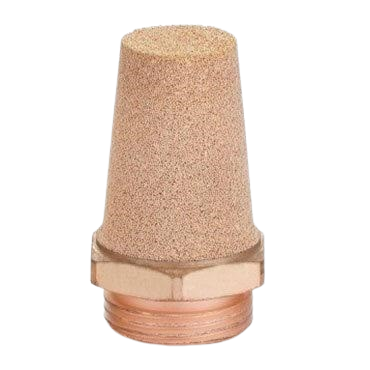
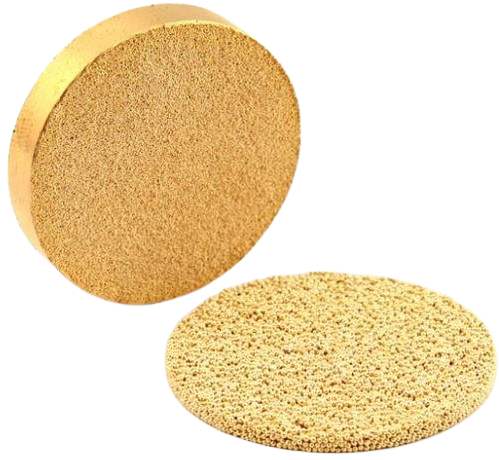
Common Design Forms:
Sintered Bronze Filter Discs
Compact porous components for filtration, venting and flow-control applications.
Sintered Bronze Filter Tubes
Tubular porous elements for applications requiring filtration through the cylindrical wall.
Sintered Bronze Filter Cartridges
Designed around a defined installation envelope and process-flow arrangement.
Custom Sintered Bronze Components
Manufactured according to customer drawings, dimensions and application requirements where technically feasible.
Key Advantages of Sintered Bronze Filters
Porous Metallic Construction
The filter is manufactured as a rigid porous metal component rather than a flexible woven media.
Controlled Porosity
The manufacturing process can be engineered to produce a defined porous structure appropriate to the intended application.
Robust Industrial Construction
The metallic structure can be suitable for industrial environments where a rigid filter component is preferred.
Custom Geometry
Filter geometry can be designed around the equipment interface and required flow path.
Potential for Cleaning and Reuse
Depending on contamination type, material and application, sintered metal filters may be cleaned using an appropriate procedure and returned to service.
Cleaning suitability must be evaluated for the actual application; it should not be assumed for every filter design.
Applications of Sintered Bronze Filters
Sintered bronze filters can be used in applications where porous metallic filtration or controlled gas/liquid flow is required.
Industrial Applications
- Hydraulic and pneumatic equipment
- Lubrication systems
- Oil filtration applications
- Air filtration
- Gas filtration
- Process equipment
- Instrumentation
- Flow-control systems
- Machinery
- Industrial automation
- OEM filtration assemblies
Application-Specific Selection
The appropriate filter depends on:
Medium + particle characteristics + required filtration + flow rate + pressure differential + temperature + chemical environment + installation geometry
Therefore, the same filter specification should not automatically be applied across different industrial applications.
